Search This Blog

Friday, February 6, 2009

My Ideal Airplane

The Camery Craft ---- Advanced Concept Design Elements

Fuel Considerations: Should be light weight. Electrons seem like an optimal choice. Easily collected and stored in a superconducting ring.

Construction material: Stable super lattices like graphene and graphane.

Construction techniques: Flux-pinned methodology.

Design: The outer hull is made of graphene and the inner hull is made of graphane. The subsonic intakes, nitrogen ionizer, and noise cancelling layers are made of carbon nanotubes. There is also a ribbon wrapping of bilayer graphene with half populated states and current flowing in opposite directions in the two layers. The accelerator consists of perforated negatively charge layers of graphene. Each layer is progressively larger the further it is from the nitrogen ionizer so as to produce a linear field that causes the maximum number of collisions between the nitrogen ions and the neutral air molecules inside the accelerator. The diamagnetic effects of the graphene help to reduce friction and channel the flow though the openings.

Safety considerations: Nitrogen atoms may be ionized but not oxygen. Linear accelerators may be used but not radial to avoid bremsstrahlung radiation. Likewise, momentum must be harvested from accelerated beams to prevent any possibility of quantum bunching, i.e., vircator like effects, causing bremsstrahlung radiation.

The usual safety instruments:
  1. A solid state, i.e., no moving parts, spread beam laser range finder to detect objects in the immediate vicinity of the craft.
  2. A solid state accelerometer and gyroscope for inertial navigation.
  3. A radio with a retractable, towed array antenna to avoid ionization effects.
  4. The Back box recorder.

Thermodynamic considerations: Some heat can be converted to electricity for extra fuel. Some heat is converted to sound. Then sound cancelling technology using carbon nanotubes can remove it. The propulsion system is designed so as to only ionize and heat up the air in front of or above the aircraft to decrease drag and increase lift.

The Propulsion System Concepts. Safety considerations should be paramount. There are many methods of transferring momentum from the craft:
  1. Collisions of accelerated particles, i.e., nitrogen ions, with neutral air particles.
  2. Diamagnetic effects.
  3. Indirect transfer from electricity or heat through the radial breathing modes of carbon nanotubes to sound.
  4. Collisions with shock waves.
  5. Bournoulli Effects.
  6. Gravity.

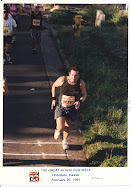
Honolulu Marathon (Start)

Thursday, February 5, 2009

Honolulu Marathon (10K and Half)

Honolulu Marathon

Atom-Sized Quantum Dots in Silicon

The two electrons in a quantum-dot Si4 ion can be pinned in place (blue and pink) by judicious position of external charges (green circles).

The quantum dot is produced by removing a hydrogen atom bonded to an Si2 molecule leaving an ion with an extra election shared between the two atoms that acts like a quantum dot. The result was discovered by a team at the University of Alberta, led by Robert A. Wolkow..

Thursday, January 1, 2009

My Favorite Graphene Joke!

How do you make a hole in graphene without creating a mobius strip?

Answer: By using the absorption of a phonon by an electron in the lower cone of momentum space to raise it to the upper cone leaving a hole. Using brute force to knock a carbon atom out of a benzene ring, i.e., hexagon, leaves a pentagon which looks like a mobius strip in momentum space.


Raman spectroscopy confirms that graphene violates the adiabatic Born–Oppenheimer approximation which is based on separating the motions of electrons and phonons, and considering these as frozen. This is invalid because of the role of hole creation in phonon propagation. It is interesting how you have three types of dark excitons and one light in nanotubes. It is even more interesting to use excitons, i.e., bound electron hole pairs, in bilayer graphene to form a Bose Einstein condensate. I read about plasmons in graphene, but do not know if they really exist.

Friday, December 26, 2008

Laverbread and Cockles

Gower on Britain's Favourite View


Laver is highly nutritious because of its high proportions of protein, iron, and especially iodine. It also contains high levels of vitamins B2, A, D, C and contains significant amounts of taurine.
It is made from seaweed which is boiled for several hours. The gelatinous paste that results is then mined and rolled in oatmeal, fried and eaten with cockles for breakfast.


The source of the seaweed used to make laverbread was historically the Gower coastline. There are still small producers of Gower laverbread (Welsh: BARA LAWNR), but most commercial laverbread is now made from seaweed gathered from western Scotland. In addition to Wales, laverbread is eaten across the Bristol Channel in North Devon, especially around the Exmoor coast around Lynmouth and Combe Martin.

Monday, December 22, 2008

Phase Transitions in Graphene


Dreaming about graphene is a beautiful thing. The leptons become light and dark excitons. Suspending graphene makes the top and bottom surfaces indistinguishable. You can even invert its handedness. Time reversal symmetry makes single layer graphene almost perfect. But bilayer is great, too. A magnetic field can be applied to change the phase of the excitons in a bilayer, half-filled system to that of a Bose Einstein condensate. When current flows in opposite directions in the two layers, the resistance goes to zero. An oddly quantized vortex binding one zero mode per valley is present, though slightly split due to a mixing of the valleys in the graphene layers. You can also have a phase transition from this coherent excitonic phase to a pair of single-layer fractional Quantum Hall States as a function of layer spacing. There is always something new to read about graphene as one drifts off to sleep.